


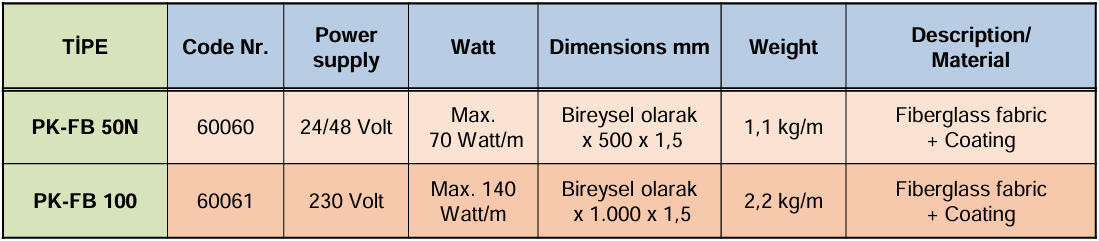
Our underfloor heating system consists of a carrier material with woven silver threads for the power supply. The Carbon Nano Tubes (CNT) dispersion is applied to the 50/100 cm wide carrier material by machine in a strip coating, ensuring consistent quality. The lengths of the heating strips are individually manufactured depending on the size of the room or the heat output. The finished heating strips are laminated on both sides to prevent moisture penetration. For safety reasons, we operate our underfloor heating system with low voltage in damp rooms. The length of the supply cable is determined according to the structural conditions in the project design, so that all cables are routed to one or more junction boxes. According to our calculations and experience, you only need around 80 Watts/m² of floor area; conventional underfloor heating requires up to 120 Watts/m². Ask your energy supplier for the cost-effective heating tariff. Underfloor heating can be controlled using a conventional room thermostat. Underfloor heating systems are manufactured in three versions, depending on the requirements.

Features
Version
1.Version: Heating strips are laid under
the screed. Also possible in damp rooms
with low voltage!
2.Version: Heating strips are laid on the
screed using the thin-bed method under
the tiles. In this case, the heating paths
are covered to ensure a tight bond to the
adhesive.
3.Version: With tile heating, the heating
dispersion is applied to the fabric directly
under the tile and laminated to protect
against moisture. The electrical
connection cables are each 5 m long
and can be shortened to the desired
length. The tile size must not be less
than 50 x 50 cm.
4.The main advantage of versions 2 and
3 is that the underfloor heating system
can be retrofitted without major
construction work.

